Founder
Early Life and Missionary Calling:
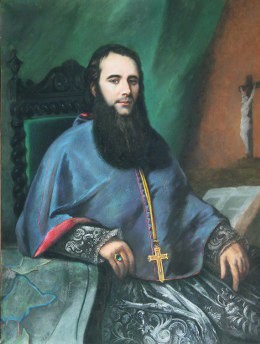
Born in Castelnaudary, France, on December 2, 1813, Melchior de Marion Brésillac came from a family with a storied history but had suffered setbacks during the French Revolution. He was the eldest of five children, and his father held a notable position as an engineer and inspector on the Canal du Midi.
Resolute Commitment and Missionary Resolutions
Before departing for India, Brésillac engaged in a retreat and articulated a set of resolutions, emphasizing his wholehearted dedication to being a missionary, spreading the Word of God, and, most notably, contributing to the formation of a native clergy.
Struggles in India
Brésillac devoted twelve years of his life to missionary work in India from 1842 to 1854. During his tenure, he confronted the prevailing caste system, which sharply contrasted with the Gospel’s message of equality before God. His efforts to challenge the caste system, particularly within the Church, met with fierce opposition.
Advocating Change and a Native Clergy
Despite these challenges, Brésillac’s pastoral and educational abilities were widely recognized. Within four years of his arrival in India, he was appointed as Pro-Vicar and later Vicar Apostolic of Coimbatore. One of his primary objectives was the establishment of a diocesan seminary. He emphasized the need for a native clergy and hierarchy, enabling other missionaries to focus on primary evangelization.
The Difficult Decision to Resign
In 1854, Brésillac traveled to Rome to personally present his case for reform regarding the caste system and liturgical customs in India. Although his concerns were listened to attentively by the Pope and the Secretary for Propaganda Fide, no immediate changes were implemented. Consequently, Brésillac offered to resign as a bishop, a decision that was emotionally challenging.
Founding the Society of African Missions
Despite his resignation, Brésillac’s desire for missionary work persisted. He sought to return to active missionary service and proposed an assignment to the interior of the West Coast of Africa. His proposal was accepted, with Rome requesting him to establish a society of missionaries for this mission. In February 1856, Rome granted him permission to create the Society of African Missions.
Growing the Missionary Community
Armed with this mandate, Brésillac set out to recruit candidates and secure funding. His missionary community gradually expanded, and on December 8, 1856, he led a group of six individuals to the shrine of Our Lady of Fourvière in Lyon, France. There, they consecrated the Society to Our Lady, dedicating themselves to the African Missions.
Legacy and Challenges in West Africa
Brésillac’s mission took him to West Africa, where he arrived in Freetown, Sierra Leone, on May 14, 1859, as the first Vicar Apostolic of Sierra Leone. He was accompanied by a priest and a brother. The region faced a dire situation, with smallpox decimating the African population and yellow fever afflicting the Europeans.
Tragic Loss and Remembrance
In a series of tragic events, several members of Brésillac’s group fell ill and passed away, with no priest available for their last rites. Brésillac himself passed away on June 25, 1859, leaving only a critically ill priest behind. There was no priest available to perform a
funeral Mass or bless his grave. Instead, a Protestant minister read prayers over his final resting place.
A Lasting Tribute
A small chapel was constructed in the Freetown cemetery where Brésillac and his companions were initially buried. Their remains were later relocated to the SMA House in Lyon, France. In 2009, Archbishop Ganda of Freetown & Bo blessed the chapel, commemorating the enduring legacy of Melchior de Marion Brésillac and his mission. The SMA continues to celebrate the Feast of the IMMACULATE CONCEPTION AS ITS FOUNDATION DAY. THE WORK AND VISION OF BRÉSILLAC CONTINUED UNDER THE care of his close friend and advisor, Fr. Augustin Planque.
Candidacy for sainthood
Since January 1928, the remains of Brésillac have been interred in the chapel of the Society of African Missions in Lyon, France. He is a candidate for sainthood in the Roman Catholic Church, and the inquiry for his beatification was concluded in May 2000. All documents were handed over to the Congregation for the Causes of Saints and await further action. Pope Francis named him as Venerable on 27 May 2020.